Showing posts with label fine art. Show all posts

Wednesday, May 22, 2019

Finding galleries when you live in the hinterlands

Semaphore
Back in October, I think, I published a 9 part series on Productivity in the Studio.  In that series I talked about finding group shows and non-profit spaces for exhibition.  That is pretty much how all of us, at least in the Midwest, start or even complete our exhibition careers.

But sometimes the work needs something different...perhaps a commercial gallery.  This is hard to accomplish from our studios located anywhere that is not a major art market.  It's hard even if you live in a major art market.  The usual way to find commercial representation is through referral from other artists, visiting galleries over and over again until you can develop a relationship,  and then studio visits.  Pretty hard to pull off from the "hinterlands."

I can't afford to fly to New York enough times a year to develop relationships with likely galleries.  I dare say you cannot either.  So, I had to develop a new way to approach this conundrum. While I cannot say I have been overwhelmingly successful, I've had 2 nibbles since I began this program in March. Here is what I am doing.

Step 1.  Look really hard at your artwork.  Try to describe to yourself what it looks like and what kinds of artwork it would look good with.  Consider the overall "look" of what you do.  Consider the media you use.  Consider your "audience."  That is a word thrown around that has flummoxed me for years.  Yes, it is your current buyers and email list...or the people you most imagine could or would buy your work.  "Audience" is both a concrete and aspirational word.

Step 2.  Start looking at galleries online.  I started with the Artsy website (They have a good online magazine as well.).  This is a strong collection of worldwide commercial galleries.  I got a sense of what is showing, what is selling and who is being shown.  I then searched this website by media that were similar or compatible with mine.  I also read Artnewspaper, Hyperallergic, Artnet and ArtNews.  Not every word, not every day, but I try to keep up.

Step 3.  Make a list of artists whose work you admire and believe your work to be compatible with.

Step 4.  Make a list of the galleries showing their work.  This information is available in many ways:                         • Artsy.net;
                   • the artists websites and resumes;
                   • google search the artists to find their exhibitions if they are not listed on their                                         personal webpages.  If they do not have their resume online, there is a reasonable                                 chance the have gallery representation.

Step 5.  Start building your database or excel spred sheet.  Information you may want to track:
                   • Gallery name. address, phone, email
                   • Owner and/or director's name and email
                   • webpage
                   • artists who referred you or you feel you are compatible with
                   •  Do they accept unsolicited portfolios  YES or NO ( A no does not eliminate them from                          your list.)
                   • Submission requirements ( ALWAYS FOLLOW THEIR DIRECTIONS                                                      PRECISELY)
                   • also provide a way to keep track when you contacted them and what the answer was.
                   •  You may want a field to keep extra notes about the venue

Step 5.  Google "galleries who accept submissions"  or a similar search.

When you are looking at gallery websites, be sure you look at their mission statement, if available, their stable of artists, their overall look, and other characteristics that might be important to you: do they do art fairs?  How long have they been in business? how can I find out if they are reliable? Do  you actually think your work belongs there?

Step 6.  Develop a series of image folders that you can easily access for this process.  For instance: I have put together 4 or 5 different portfolios based on themes in my work.  It makes it easier to go through this process more quickly...less searching and "re-invention of the wheel."

Put an up-to-date resume, bio and artists statement (pdf form) with these images so  they are quickly available as well.

Make sure your website is up-to-date....at all times.
•••••••••••••••••••••••••••••••••••••••••••••••••••••••••••••••••••••••••••••••••••••••••••••••••••••
OK, now you are sort of ready to begin to send out information to galleries that are seeking submissions.  Do exactly what they ask.  Most are email contacts.  Some only want a website link, some want 3-5 images, some want 20. Some want small sized images, some want giant images sent to dropbox.  Some want sales history, some want press clippings, some want other mysterious things.  Do your best to precisely follow their requirements.

But with all of them you will need some kind of cover letter.

This is where your research will really help you.  Cover letters should be short, polite, to the point and uber gracious.

My successful letters referenced the gallery's program, specific artists they have shown and one of the letter's mentioned my fond memories of the town, since it was my grandfather's home town!

Whenever possible, address the owner or director by name, Mr. Gallery Owner, Ms. Gallery Director.  Make the letter a brief and personal as possible, while maintaining formality.  Often the gallery director is the more active chooser of new art.  Fulfill their requirements precisely.  But, as a matter of course, it is a good idea to invite them to view your website, using an active link in the body of the email, for more complete information.

Remember, even if they actively seek submissions, their time is valuable.  Be kind.  Thank them for taking the time to look.  Never, I mean NEVER, do a follow-up email/phone call unless invited to do so. It's not like a job interview.  The etiquette is different.  The jury is out about whether to ask for referrals.  Sometimes I add that "if the work does not fit your program, I would welcome referrals." Some find this pushy and pushy is a big no-no in gallery submission etiquette.  I think it is OK if done gently.

As a side note:  it is a good idea to have your webpage address be part of your email signature.  Then, if  anyone is  curious, they automatically have the link.

If you do get an affirmative or "maybe" response, do respond immediately and graciously, and cross your fingers for the future. Do not hound them.  Keep in touch with postcards of shows, an occasional newsletter.  Send notes when you see artwork in their galleries that really excite you. But keep it truly occasional and undemanding.  You are just starting a relationship.  It is a kabuki dance for sure.

WHAT IF THE GALLERY YOU REALLY WANT HAS A NO SUBMISSION POLICY?

I have not made it to the "no submission" part of my database yet.  But, here is the plan.

If you really, truly believe the gallery would be a good match: say so.  But only do this after following the gallery for sometime.  Know what you are talking about.  You might write an email that says , "I would like to introduce you to my work. I have been following you exhibition program for sometime, especially the exhibitions of artists "so and so," and I believe that I could be a benefit to your program."  Now that is pretty pushy...so you might soften it somehow, but keep it short.  Include a website link and maybe a couple of images, but not many.

It might be a longer campaign that begins with postcards from new exhibits your are in, with emails asking about aspects of the current show in that gallery, with in person visits if you can.  I have a couple of galleries I am following pretty closely who have "no submission" policies.  I have emailed them with questions and congrats about their shows, and received gracious responses. That is my first step.

HOW DO WE DO STUDIO VISITS IN THE HINTERLANDS?

 I have yet to do this, but I hear that galleries are starting to do Skype and Facetime visits!  How cool is that?


SO, that is where I am at in this late-in-life push in my art career.  If you have anything to add...please do!  I'd love to get a conversation going.

Tuesday, January 22, 2019

Completing new work is:

Completing new work is always:

  • slow
  • curious
  • exciting
  • frustrating
  • mysterious
  • sometimes expensive


I have finally completed a few new pieces and they have each, in its own way,  ticked all the boxes above.

CASCADE
The first one completed is CASCADE.  It is a multilevel digital embroidery piece inspired by the stripes of Bridget Riley.  The surfaces float at various real levels and cascade to the floor.  The modules are formed around 1/4" plywood.  On the wall they attach to screws with magnets.  On the picture plane, they are permanently affixed with bolts and tubes.  The one little module that hangs off the picture plane is velcroed for safety in shipping and storage.  The floor modules are 2-sided.  60" x 28"

STAX detail
STAX
The second piece is STAX, also inspired by Bridget Riley.  It is built of 3-dimensional modules, mounted on a lovely walnut frame.  Had to use my non-existent upholstery skills to make these modules!  However, my old bookbinding skills came into use:  I built the forms from book binder's board, sewed the half tubes and then stretched and upholstered using a curved coptic stitch needle! And then I did woodworking! 13.5" x 47"


This crazy mixed media piece started as Bridget Riley stripes, a color study gone awry. The colors lay dull and flat on the rich fabric.  But after hours of stitching, I could not quite throw it away.  It hung around for quite awhile, indicting me not only on my color/thread failures... but also asking what might be next.

Meanwhile, STAX was in process.  Digital embroidery is always backed with a variety of stabilizers to support good stitch outs.  Think: Pellon or INTERFACING if you sew.  Some stabilizer can be torn off the design when it is done.  In making the modules for STAX, I tore away a series of near perfect stencils;-)  So, I used them to block out new areas of color on this piece and  continued with oil pastels and pastel pencils. It has no title yet, but I do love it.  It has mysterious sense of depth.

The next pieces in the queue are very complex...or at least LARGE.  There is a lot of sweat equity ahead before there is much to show on the embroidery front.

Tuesday, May 8, 2018

Platonic Solids


Pla·ton·ic sol·id
noun
plural noun: Platonic solids
  1. one of five regular solids (a tetrahedron, cube, octahedron, dodecahedron, or icosahedron).

Triple Dualities


Platonic describes our friendship...but also certain kinds of geometric solids.  And, within these regular solids are Dualities!

PLATONIC DUALITIES
recent art of Susan Hensel and Kim Matthews
opening Friday May11, 6-9pm
Gallery 5004, Robbinsdale, MN

It's an easy drive up 100 N, 10 minutes north of the city.  Just remember that I94 has inconvenient weekend closures right now!


Tuesday, May 1, 2018

Torus Fever

I have become fascinated with the geometric form torus.  It is, fundamentally, a donut...which is something I used to love and can no longer eat!  But more than that, it can be seen as a depiction of a black hole, or a universe...or...or...The online dictionary defines it thusly:

to·rus
ˈtôrəs/
noun
noun: torus; plural noun: tori; plural noun: toruses
  1. 1.
    GEOMETRY
    a surface or solid formed by rotating a closed curve, especially a circle, around a line that lies in the same plane but does not intersect it (e.g., like a ring-shaped doughnut).
    • a thing of this shape, especially a large ring-shaped chamber used in physical research.
  2. 2.
    ARCHITECTURE
    a large convex molding, typically semicircular in cross section, especially as the lowest part of the base of a column.
  3. 3.
    ANATOMY
    a ridge of bone or muscle.
    "the maxillary torus"
  4. 4.
    BOTANY
    the receptacle of a flower.
Origin
mid 16th century (sense 2): from Latin, literally ‘swelling, bolster, round molding.’ The other senses date from the 19th century.
Cushion Torus

Cushion Torus: Universe

Intersecting Torus 1

Intersecting Torus 2

Torus 1
PLATONIC DUALITIES, opening May 11, 6-9pm, Gallery 5004, Robbinsdale

Tuesday, November 10, 2015

A Cheese Box of...

 Since this summer, and the Women's Art Institute at St. Kate's,  I have been working with shell/vulva/pod forms in all sorts of media: 
    pastel
   graphite
   embroidery by hand and by machine

In fact, this is the form I have committed to exploring for a year. It will be interesting to see where it takes me.

This particular piece,  A CHEESEBOX OF VULVAS,  will be showing in Detroit, MI December 4- January 23, 2016  at Whitdel Arts in the show titled CROTCH: Contested Territory.  How could I NOT apply to this call?

The units are about 7" tall, muslin and sometimes calico prints, high loft batting sandwiched between the layers, embroidered on my Babylock machine with designs that I drew, cut-up and reassembled, scanned, re-drew and then digitized into these designs.  There are 50 units in this iteration.  I find it funny to see them peeking out of this old cheese box!  They are like a garden.  I can also see them proliferate and hang about a space, dangling in mid-air, jittering around as the brezzes pass through.


Monday, November 2, 2015

Repetition and Pattern, Fredericksburg Gallery, Fredericksburg, Virginia

Three of my artworks were selected for the show Repetition and Pattern, at Fredericksburg Gallery, in the Fredericksburg Virginia Center for the Creative Arts, a partner with the Virginia Museum of Fine Art, guest curated by Amie Oliver.

The show opened Halloween, but the opening celebration is Friday, Nov 6, 6-8:30pm. Wish I could be there. If you go, do let me know.


Some Pebbles and Statistics are premiering in Fredericksburg.  Inventory Methods was shown in the windows of Susan Hensel Gallery earlier this year.
Some Pebbles


Statistics

Inventory Methods

Sunday, November 1, 2015

In Stitches


                                            IN STITCHES
Terra Firma # 2


Patterns of India:Pearls of India


I am pleased as punch to announce that I will be showing some little seen work in a solo show at Lake Nokomis Presbterian Church, 1620 East 46th St., Minneapolis, MN. While we are not planning an opening event, you can contact me or the church to set a time to see the exhibit beginning November 5, 2015.  The end date is unclear, but it may be up until roughly Christmas. The church phone # is 612-721-4463 or you can email me at susanhensel@yahoo.com.


IN STITCHES is an exhibit of two bodies of work:
Terra Firma  and Patterns of India

Terra Firma reminds me of home.  I grew up in the Finger Lakes area of New York State, tramping up and down hills and through deep gorges cut by glaciers, revealing waterfalls, rock strata and fossils, an overwhelmingly physical representation of time.

Terra Firma is a series of mixed media artwork built from drawings on Fabriano paper, done in waxy colored pencils, ink and gouache that have been torn, re-ordered and reconstructed into sedimentary layers, tossed and folded by continental drift.  They are machine stitched and mounted on black linen and Folio printmaking paper.

Patterns of India is a response to a show I curated on the diaspora from the Indian subcontinent to the United States.  I read oral histories, met local Indian artists, heard their stories, ate wonderful food and became increasingly curious about the colors of the subcontinent.  I collected images of Indian miniatures, photos of the blue cities, dye pots and stacks of colorful fabrics as inspiration.


Patterns of India is built from drawings done in oil pastel, pencil, acrylic paint, ink.  The drawings were torn, reassembled and held together with stitches, lovely stitches and beads.

Tuesday, January 20, 2015

Installation day at Hopkins Center for the Arts


Transformation: The Works of Susan Hensel & Janna Rhae Johnson

Opening reception for this show is Saturday, January 24 from 6-8pm.

Today was installation day...always an exciting day.  I am showing the series REINVENTED PAST in this two person show at  Hopkins Center for the Arts.


Installation begins!
Dale measuring
Figuring out locations

Janna Rhae Johnson


Hopkins Center for the Arts

1111 Mainstreet
Hopkins, MN 55343
Gallery free and open to the public
Monday-Friday: 8am–8pm
Saturday: 10am–8pm
Sunday: 12–5pm


Friday, January 10, 2014

The Pin Wall


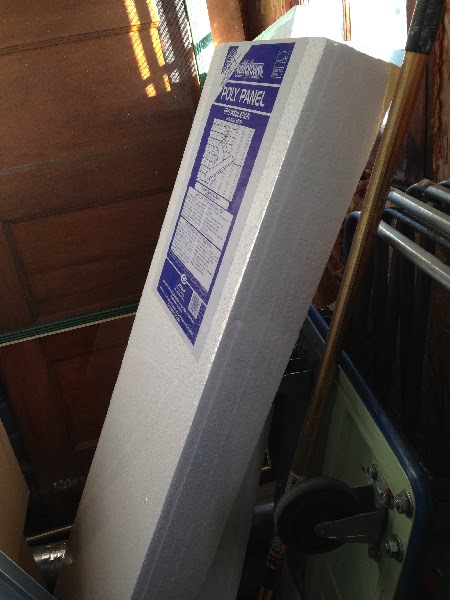
The pinwall went in today.  It is 8 feet x 10 feet of styrofoam.  Holy Moly!  It is frighteningly huge and is only 1/2 of the project size!  Nothing pinned to it yet...but just wait!  Next week I will start.  Boy it scares me.  What if I do not like what I see?
I started 20 new modules today.  They are nearly ready for sewing.


This project is physically grueling.  Today was an aching day.  The weather changed swiftly from dry arctic cold to moist spring-like 30 degees.  The old bones objected.  But carrying on is the only option...and an Aleve.

I continue to make ergonomic decisions for the studio.  Risers under table legs for working standing up.  An anti-fatigue mat for the ironing area.


But still, the body objects today.

Hardware, models and testing

Extruded aluminum channel: 16 feet
I am beginning to accumulate the hardware and random tools necessary for assembly  of the Habitat for Humanity project.  The assembly schedule starts roughly February 1.  Of course there is much work to do before then.  Not only do I need to finish the modules (roughly 100 more of them), I do need to experiment with composition and with assembly materials and practices.

Dale is starting to work with me today.  Our first job is to build a pin-wall so I can begin to work out the composition.

Because I could not fit 4' x8' sheets in my car, I decided to buy styrofoam panels and lots of velcro to attach the panels to my wall.
 
The experimental crimps will arrive over the weekend.  Dale and I plan to make  matboard models to test and perfect the grommeting and wiring process.

I bolts and lock washers to hold EVERYTHING