Showing posts with label Cairns. Show all posts

Sunday, September 19, 2010

Spinning: learning stories & politics

I don't know why, but I am shy about taking people's photos. Actually, despite what my blog might seem to imply, I am shy about having my own picture taken. All the photos of me in the blog are compliments of tourmates offering to take my picture.
In the Cairns airport, waiting for our flight to Sydney, I got out my beautiful Golding spindle to spin a little merino silk. My son gave me this spindle for Christmas last year and it quickly became my favorite.
I have found that spinning in public creates opportunities for most amazing conversations.
The woman next to me was waiting for a plane to Brisbane. Her name was Melba and I was too shy to ask to take her photo. She was a very pretty woman who looked quite Polynesian. She had been in Cairns for an Indigenous Rights Conference. Her family, on her mother's side, descended from slaves, stolen from islands (perhaps in the Fiji chain), stolen to work in the cane fields of northeastern Australia.
Melba told me about one of the papers she heard at the conference, given by an Arizona anthropologist who had lived 30 years with one Aboriginal group on the Bay of Carpentaria, in Northern Australia. He learned the language and the customs, the history and the beliefs. His paper was on the subject of preserving the strong, successful, original ways of living on the land while still participating in the modern world.
Melba said that the "Sorry" was a start. Many people we talked to referred to the "Sorry", the official apology of the AUstralian government to the "stolen generation: of Aboriginals made in February of 2008.
"Between 1920 and 1970, the government took Aboriginal babies away from their parents on a large scale, and re-housed many of them with white families. Many of these children were abused, though for some it meant the chance of a better life. At the time, it was official Australian policy to give Aboriginal children a ‘white' upbringing, as the government was convinced that the Aboriginal culture would die out.

Already in 1997, the distress of the "stolen generations" was recognized by an investigation commission that advised the Australian government to offer its apologies. The previous Prime Minister, liberal John Howard, refused on the grounds that it was not his government's responsibility." (read more here.)

She and I taked at length about how does a people manage when t heir land specific culture has been broken? How does one transition to something t hat works better in the larger colonial culture? She went on to talk about some of the similarities with the Navaho people. Hunting & gathering skills and beliefs...about there being some universality. Melba stated that while the "Sorry" was, indeed, a start...it is not believed that the prime minister has made sufficient effort to understand the indigenous beliefs and way of living.

I believed her. The all consuming nature of Western culture is so at odds with the slower, considered, efficient conservation of the aboriginal way. Melba talked of the importance of the dances, telling stories, mimicking animals...it keeps the land alive.

The day before we also had a lecture from Ernest, a representative from Tjakupi, about northeastern indigenous groups: the rainforest people are shorter and lighter skinned than the desert groups. His description of traditional social structure sounded somewhat different that the structure I heard about in the Red Center. Doug, at Desert Park, stressed the relative gender equality in the Arrende people. Men and women had different but equally important and respected roles in the survival of the group. Ernest described a more uneven power structure in Tjakupi, saying that men's hunting was the most important activity. Both stressed a respect for elders.

The comparisons of the expression of the tribal LAW, were different as well. If marriage laws were broken, Arrende would banish the couple, and they would wander alone, no other group likely to take them in. Tjakupi would physically attack the couple : women were raped, men were speared.

The Tjakupi group was described as a clan structure, rather than as language or skin groups as in the desert. The clans were classified as wet or dry groups and membership in the clans determined your marriage possibilities, protecting the genetics in the same way as the desert groups. Rainforest aboriginals were traditionally promised in marriage almost at birth, older men promised to much younger women. Earnest had been promised to twins! But, as is increasingly common, he married for love.

I was too shy to take Earnest's picture as well.

Birds, birds, birds

At Birdworld in Kuranda, an Indian Blue Ringneck. A star finch and Chestnut Mannikins Cassowary Cassowary Some kind of dove doing some kind of display. There were 3 of them in a row, spreading their wing feathers, cocking their tails, contorting their forms. They did not appear to be distressed, did not appear to be performing a diversionary display nor a mating display. It was more like quiet sunbathing. Extended Senegal Dove sex. This pair was blocking the sidewalk for quite a while. Made me sing the old Beatles song "Why don't we do it in the road!" a rather large parrot. Smaller parrots...maybe .

Saturday, September 18, 2010

Wetherby Station

On the way to Wetherby Station, we stopped at The National Hotel in MT Molloy. After many many hairpin turns, going UP, toward Wetherby, we stopped for a beer or a shandy. The National Hotel is an OLD roadhouse with rooms. The owner regaled us with tales of poisonous snakes in the rafters. The second floor is surrounded by open porch. Each bedroom opens onto the porch for maximum air movement. I want to stay there (except for the lack of security!). A Shandy? You didn't tell us what a SHANDY is! Well, I thought it was pretty vile! A shandy is 1/2 lemonade and 1/2 beer. Understand that lemonade in Australia is Sprite! I did not finish it! Wetherby Station is a working cattle station and tourist spot...I think they call it cattle tourism;-)
We were met at the corral by John Colless on horseback. The station was built in as a homestead in 1879, one of the oldest in the district. It was a stop on the way to the gold fields. The cattle introduced to the area were a cross between brahmins and zebu, making them a smallish, hardy, drought tolerant cow. They are all grass/range fed...organic to the max. They try to run the station in a sustainable manner. They use no herbicides or poisons (except when the dingos get too populous.) There is no shooting on the station except at the gum trees and ironwoods to harvest the seeds! They have a fire plan for the whole area...the station is responsible for the safety of their 26 neighbors. They do use controlled burns to maintain the land, dropping incendiary ping pong balls from helicopters to control the grasses that otherwise would form a serious fire threat to the whole area. There is much wildlife in the area: snakes : Taipans (lose one or 2 calfs per year to them), pythons. Birds: cattle egrets, kookabura, plover and many more listed on their website. Wallabies and kagaroos, termites, fish. It is a lush rich area. They weigh the steers from time to time to determine which are going to which market. Did you know that steers with broad haunches are sent to Korea; old steers to Japan; slender steers to Indonesia to be fattened on sugar cane waste? John mustered this bull and his cows for us. they were very beautiful, healthy animals. A sculpture up by the house. orchids! Love those bromeliads! Various unidentified buildings on the property.

Friday, September 17, 2010

The bower at Wetherby Station

We had a dinner at Wetherby Cattle Station, northwest of Cairns, in Far North Queensland in the township of MT Molloy. While it is now listed as Mount Molloy, originally the MT mean mining town. I will tell you more later about our experience at this station in the rainforest. One of the most exciting things was seeing the bower bird nest. This bower bird, who we never saw, collects seashells and red plastic for his palace. The nest was about 18 "tall and covered quite a bit of real estate! This bower was in their yard, along the fence next to the road that led into their property. They said that there is another bower being built out in the field by a younger male. They also said that when they are missing odd things from the kitchen, they go check the bowers.

Wednesday, September 15, 2010

Cairns Botanical Garden

We had a brief, but lovely, visit to the Cairns Botanical Garden. Of course, it was lovely! It's a tropical garden after all! But what was especially nice was the events transpiring there that morning. There was a cellist playing beautiful music and people clearly setting up for a photo shoot or an event of some kind. The place was oozing with the creative juices of plant-kind and human-kind.

Tuesday, September 14, 2010

Skyrail in Cairns

After the visit at Tjakupi Cultural Park we rode the Skyrail to Kuranda. Susan Pomerantz looking out, over the rainforest. The Skyrail is 7.5 km long, skimming above the rainforest canopy. Just peeking into the frame is Betsy, who is conquering her fear of heights...and did very well. quoting the website:"Skyrail Rainforest Cableway, Cairns Australia, is a world first in environmental tourism taking you on an amazing experience over Australia’s World Heritage listed Tropical Rainforest canopy and deep into the forest."
It was a 90 minute ride above the canopy. Most of the time, I was not aware of how high we were travelling...until I looked down HERE. I was not as excited about riding OVER the rainforest as I had been about walking in the Puerto Rican rainforest or the rainforest in Washington State. But, I must admit, this makes so much more environmental sense. The fragile ecosystem is far more protected this way.
There was a midway stop where we took a walkway overlooking Barron's gorge. A moorhen crossed our mossy path.
We disembarked at Kuranda where I had my last kangaroo pie. Meat pie is very popular in Australia. Think potpie that you can hold in your hand. The place we went to had many many different kinds of pies. I don't dislike kanagroo meat (except for imagining their beautiful eyes!), but ground meat in gravy wrapped in a fatty piecrust is just not my thing. I did go on to have a couple of sausage rolls elsewhere. Liked those better.
Kuranda looked like a tourist trap to me. I missed out on some legitimate galleries, I guess. But I went to Bird World and saw lots of cool birds. I'll show them to you tomorrow.

Monday, September 13, 2010

Tjakupi

AT Tjapuki we learned to throw boomerangs... sort of. I still throw like a girl! Right into the ground. The returning boomerang is native to the rainforest Aboriginals, used in bird hunting especially, to flush out the game. Tjakupi is a Cultural Park near Cairns that highlights Aboriginal culture. Before you go to their performance, you watch a movie of the history of Aboriginals in the time of colonialism. It was a no holds barred documentary of the generations of abuse of the native peoples, some from ignorance, some from intent. These beautiful young men are all of Aboriginal descent. There is not just one tribal type. The Aboriginals of Australia appear to descend from several groups that emigrated to the continent between 30,000 and 60,000 years ago. Those who traditionally inhabited the rain forest, tended to be paler skinned; those who inhabited the desert looked more African. There are over 300 language groups in Australia, some so vastly different that they must have arisen independently. These young men are professional singers, musicians, actors and dancers. They were very impressive, by Western standards. They imparted much information in a very slick, palatable way. It wasn't pandering. They were clearly very proud of their abilities and their heritage. It was a method that I think worked to make the mysterious more understandable. The power of art.
They gave us a behind the scenes talk about "bush tucker," showing us a plant that could be sucked on for caffeine, broken open for nuts, and shredded to form a paint brush. They talked about there dry & wet language groups: presumably desert vs rain forest. The organization they described for the rainforest people sounded more patriarchal than the desert peoples. They explained the dilly bag, a woven net bag, that was used for collecting and carrying food stuffs and for rinsing the toxins out of some the the foods. Traditional, old clothing, would be little more than pubic coverings, often made of human hair.

Saturday, September 11, 2010

Cairns and the Great Barrier Reef

Cairns (pronounced Cans) is a pretty city that knows that it is ALL ABOUT THE REEF and sugar cane. Cairns is the main tourist destination for visits to the Great Barrier Reef. There is a beautiful esplanade along the waterfront, with lovely viewing platforms to view the birds. I saw a spoonbill crane? stork? Actually, I saw a group of them. The public pool, at the end of the esplanade, was the scene for morning aerobics.
Across from our hotel was a church with some of the most amazing historical stained glass I have ever seen!
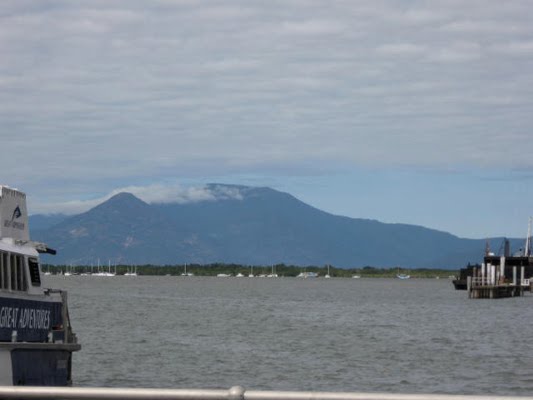
But the reef, you ask, "What about the reef?" the day we went to the reef was pretty rough, very windy. It too 2 dramamine hours to get to the Diving Platform on the reef. Actually, it took us 3 hours. The boat stops midway, at Green Island, for a less immersive experience. The boat broke down and we were at the dock for an hour while scuba divers fixed the broken hydraulic line.
It was also on the cool side. Remember, we were there in Winter.
The water was so choppy and the number of people on the water was so high, that I saw no fish and very little coral the one time I snorkeled. Good news: I could see through my prescription lens mask and I did not suffer any panic, nor did I snort any water. It was just unpleasant. The water was reasonably warm, but I kept getting blown farther from the boat and the resting places than was comfortable. So I went back on deck, had lunch and took the semi submersible boat ride.
I saw much more coral from the boat. It all looked rather blue, like the photos, because of how the water filters the light.
Those who scuba dived saw the true colors...but not me.
The most fish I saw, outside of Sydney Aquarium, was when these people illegally fed the fish from the diving platform.